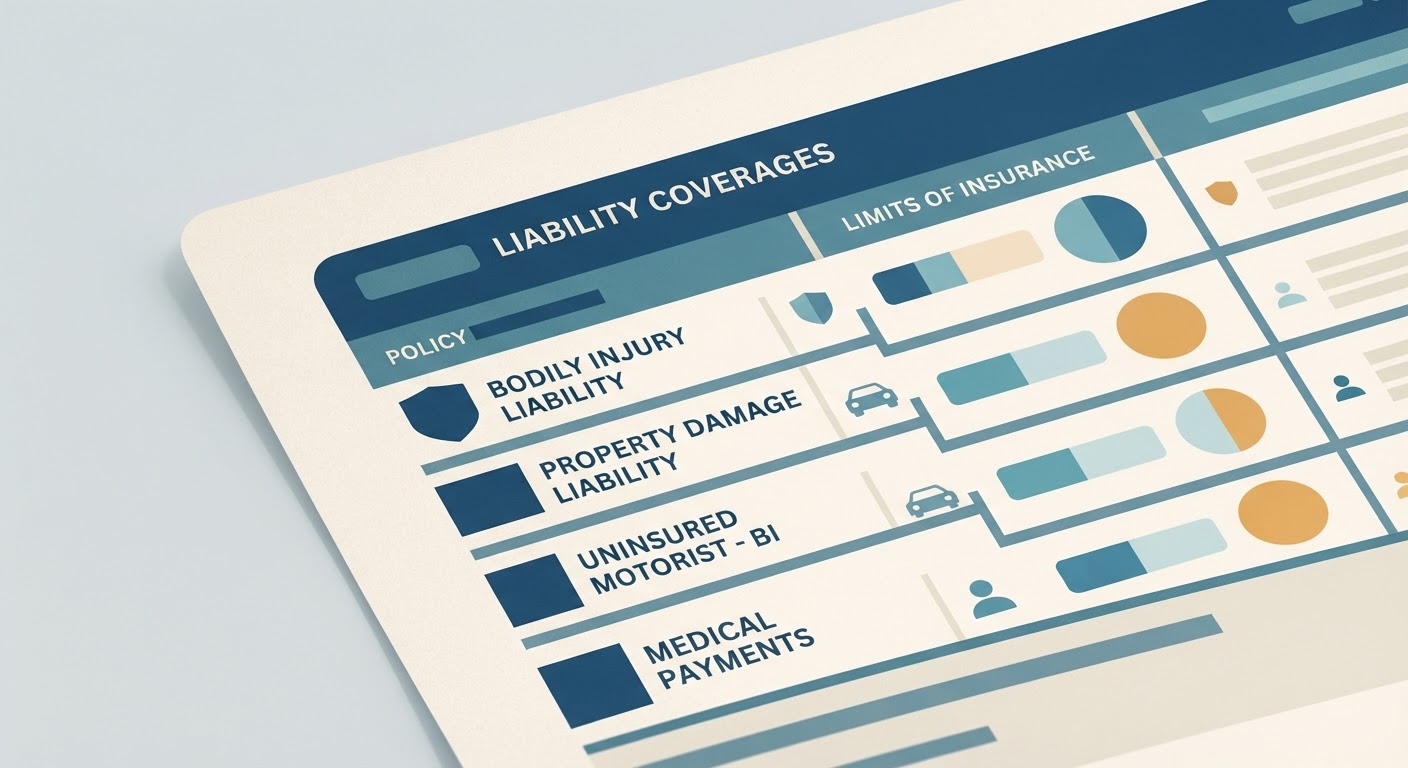
Look at the declarations page of your auto policy — the summary sheet usually near the front — and find the line labeled “Bodily Injury Liability” or sometimes “Liability Limits.” Next to it you’ll typically see three numbers separated by slashes, something like 100/300/50. These aren’t random codes. Each number is a separate dollar cap, expressed in thousands, that limits how much your insurer will pay out for a specific category of damage if you’re found at fault in an accident. Understanding what each slot represents is one of the most useful five minutes you can spend with your policy, because it tells you exactly where your financial exposure begins if a claim exceeds what your insurer will cover.
Reading the three numbers on your policy
The format is standardized across almost every insurer and every state, which makes it easy to compare once you know the pattern: first number / second number / third number, each one representing thousands of dollars.
The first two numbers apply to bodily injury liability — the money your insurer pays on your behalf for injuries to other people in an accident you caused. The first number is the cap per injured person. The second number is the cap for the entire accident, no matter how many people were hurt. The third number is a completely separate coverage, property damage liability, which pays for damage to someone else’s car, fence, mailbox, or storefront — not people, just property.
So a policy showing 100/300/50 means: up to a certain amount per injured person, up to a higher combined amount for everyone injured in that one accident, and a separate amount for property damage. These three limits don’t share a pool of money with each other. Running low on the property damage limit doesn’t let you borrow room from the bodily injury limits, and vice versa. They’re three distinct buckets, each with its own ceiling.
Some policies simplify this into a single “combined single limit,” where one number covers both injury and property damage for the whole accident without splitting it into per-person and per-accident caps. If your declarations page shows only one number on the liability line instead of three, that’s likely what you have, and the logic below still applies conceptually — it’s just not divided into separate compartments.
Where to find your actual numbers
Your specific limits are printed on your policy’s declarations page, and they’re also usually visible through your insurer’s online account or app under “coverages” or “policy details.” If you’ve never checked, it’s worth doing now rather than after an accident. The limits you’re required to carry can vary by state, and the amount that feels adequate depends on factors like your assets, your typical driving environment, and how much traffic and how many expensive vehicles are common where you drive — none of which a generic article can size for you. Your insurance agent or your state’s department of insurance website can tell you what’s currently required where you live and what optional higher limits are available.
What the first number covers
The first number is the per-person bodily injury limit. It caps how much your insurer will pay for the injuries of any single individual hurt in an accident you’re responsible for. That includes people in other vehicles, pedestrians, cyclists, and passengers in your own car (subject to how your policy defines it) — but it does not include your own injuries, which are handled by different coverages like medical payments or personal injury protection, not by your liability limits.
What counts toward this per-person cap can include the other person’s medical bills, rehabilitation costs, lost income while they recover, and in some cases compensation tied to pain and suffering. All of that gets totaled up for each individual person, and your insurer pays up to the per-person limit for that one person’s claim. If the costs tied to that individual’s injury exceed the limit, the excess isn’t covered by this part of your policy at all.
It matters to think about this number in isolation from the others because injury costs — especially involving hospitalization, surgery, or long recovery periods — can escalate well past what a lot of drivers assume is “plenty.” A single serious injury claim can consume a per-person limit that once seemed generous, particularly if the limit was set years ago and hasn’t been revisited since.
What the second number covers
The second number is the per-accident bodily injury limit — the total ceiling across everyone injured in that one accident combined. This is the number that starts to matter most when more than one person is hurt: multiple occupants of another car, a driver plus a passenger, a group of pedestrians, and so on.
Here’s the mechanic worth understanding: no single injured person can receive more than the first number (the per-person cap), even if the second number is much larger and there’s technically room left in the overall accident total. The per-accident limit is a ceiling on the sum of all the individual payouts, not a way to funnel extra money to one especially costly claim. So with a 100/300 split, one injured person can be paid up to 100, but if four people are injured in the same accident, the combined payout across all four still can’t exceed 300, and no one of them individually can exceed 100 regardless of how the math divides up.
This is where the difference between a low-injury and a multi-injury accident becomes financially significant. A single-car accident with one other injured driver might stay comfortably under both numbers. A multi-vehicle pileup with several injured occupants can approach or exceed the per-accident total surprisingly fast, even when no individual injury alone would have exceeded the per-person limit.
Why insurers split it this way
Splitting the bodily injury limit into a per-person and a per-accident number lets insurers price risk more precisely and lets policyholders understand two different exposures at once: how bad can one person’s claim get, and how bad can the whole accident get if several people are hurt. Thinking of it as one undivided lump sum would obscure the fact that a bad multi-injury accident behaves very differently, financially, than a bad single-injury one.
What the third number covers
The third number is property damage liability, and it’s a separate coverage from the first two entirely — it doesn’t share a limit with bodily injury at all. This is the amount your insurer will pay, per accident, for damage you caused to someone else’s property. Most often that means the other driver’s vehicle, but it can also include things like a fence, a garage door, a utility pole, a storefront window, or anything else your car damages in the course of the accident.
Because it’s a single per-accident number rather than split into per-item and per-accident like the bodily injury side, all the property damage from one accident — however many vehicles or objects were involved — draws from this one limit. If you cause a chain-reaction crash involving several vehicles, the combined repair or replacement costs for all of them come out of this single third number, not from three separate pools.
Property damage costs can climb quickly in ways that are easy to underestimate. Modern vehicles, even ordinary sedans, often cost more to repair than older intuition suggests, thanks to sensors, cameras, and structural components built into bumpers and panels that used to be simple sheet metal. A relatively routine-looking fender bender involving a newer vehicle can produce a repair estimate that eats a meaningful chunk of a property damage limit that might have felt generous for an older-model accident a decade ago.
What happens if the damage exceeds the third number
If the total property damage from an accident is higher than your property damage liability limit, the difference isn’t automatically absorbed by your insurer or by the bodily injury portion of your coverage — it’s a separate exposure that sits outside those three numbers. This is one of the main reasons drivers choose to carry higher liability limits than the ones required in their state, or to add an umbrella policy on top of their auto coverage: not because anything is wrong with the minimum structure, but because the gap between a low limit and a real-world repair or medical bill can be wider than expected.
Putting the three numbers together
It helps to picture your liability limits as three separate accounts rather than one lump of money. The per-person bodily injury number caps what one injured individual can draw. The per-accident bodily injury number caps the combined total across everyone injured in that one event. The property damage number is its own account entirely, covering the physical damage to other people’s belongings and structures, with no crossover between it and the injury side.
When you’re reviewing your policy, it’s worth asking, for each of the three numbers, whether it feels adequate given how you actually drive: how much traffic you’re regularly in, what kind of vehicles are common on your routes, and what you’d want covered if an accident involved more than one injured person or more than one damaged vehicle. There’s no universal right answer to what these numbers should be — it depends on your circumstances and on the specific requirements in your state, which your insurer or your state insurance department can confirm. But knowing what each of the three numbers actually caps, and that they don’t share resources with each other, makes the declarations page a lot less cryptic the next time you look at it.