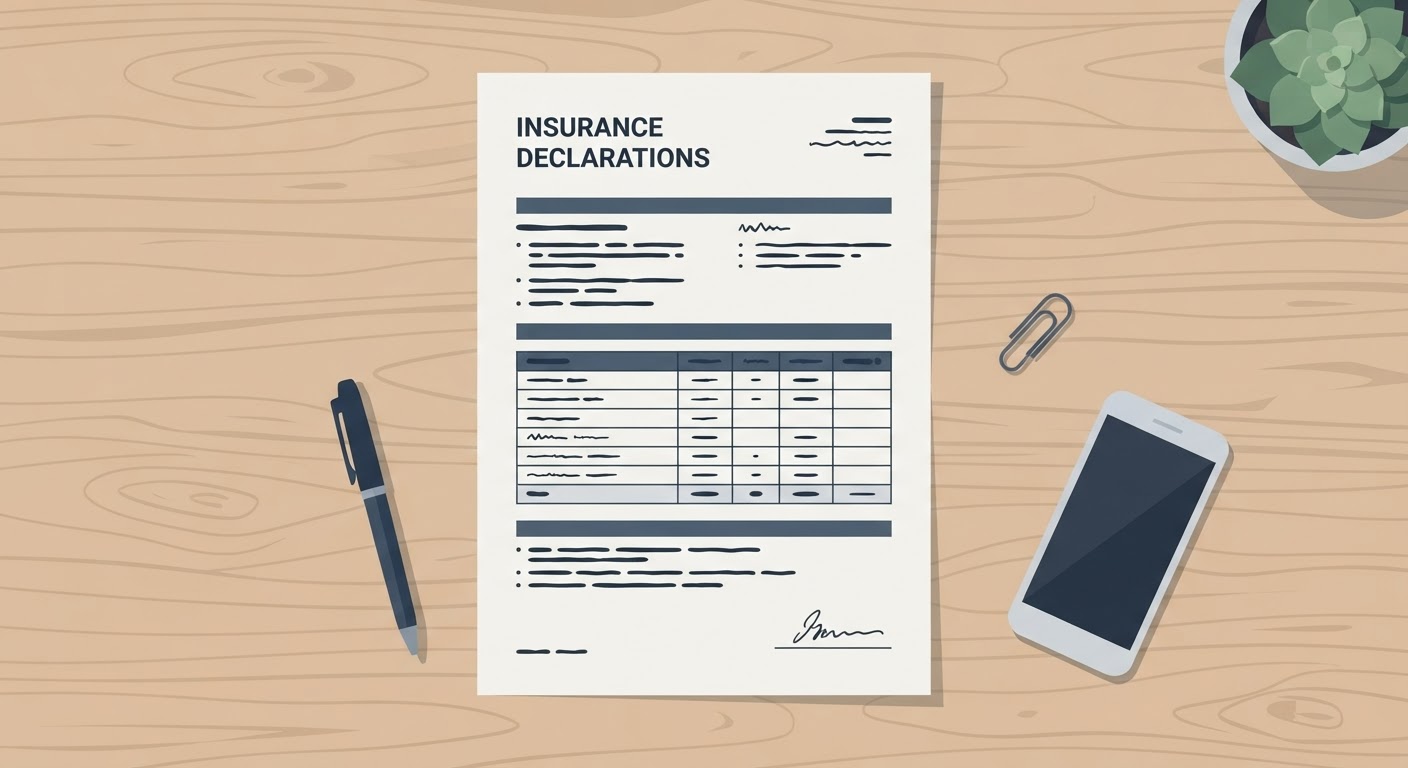
Every auto insurance policy comes with a summary page tucked at the front of the packet, usually one or two pages long, dense with abbreviations and numbers arranged in a grid. Most drivers glance at it once when the policy arrives, confirm the premium looks about right, and file it away. That page is called the declarations page, often shortened to “dec page” by agents and adjusters, and it is worth learning to read properly, because it is the single document that tells you what your policy actually promises to do.
What a declarations page actually is
The declarations page is a summary, not the contract itself. The full contract — the part that explains definitions, exclusions, and the conditions under which the insurer will or won’t pay — lives in a much longer document sometimes called the policy form or policy booklet. The declarations page pulls the essential facts out of that longer document and lays them out in one place: who is insured, what vehicle or vehicles are covered, what coverage types apply, what the limits and deductibles are for each one, and what period of time the policy covers.
Think of it as the label on a prescription bottle rather than the pharmacology textbook. The label tells you the dose and the schedule; it doesn’t explain everything the medication does. Similarly, the dec page tells you the shape of your coverage — the categories and the dollar amounts — without spelling out every exclusion or condition that governs how a claim gets handled. When something goes wrong and you need to understand exactly what’s covered, the dec page tells you where to look, but the full policy form is where the fine print lives.
Because it’s a summary, the dec page is also the fastest way to check that your policy matches what you actually agreed to buy. Insurers update these pages every time something changes — a renewal, an address change, a new driver added to the household, a vehicle swap — so the version you’re holding should reflect the most current terms of your coverage as of its effective date.
Where to find your coverage lines
Near the top of the page, after your name, address, and policy number, you’ll typically find a block listing the vehicles on the policy, each identified by year, make, model, and the last several digits of the vehicle identification number (VIN). Below or beside that vehicle information sits the part most people find confusing: a table of coverage lines, each with its own name, its own limit, and sometimes its own deductible.
Here’s what the common ones mean:
- Bodily injury liability — pays for injuries to other people when you’re found at fault in an accident. This is usually listed with two numbers, such as a per-person limit and a per-accident limit.
- Property damage liability — pays for damage you cause to someone else’s car, fence, mailbox, or other property when you’re at fault.
- Collision coverage — pays to repair or replace your own vehicle after a collision with another car or object, regardless of who caused it, subject to your deductible.
- Comprehensive coverage — pays for damage to your own vehicle from causes other than a collision: theft, vandalism, fire, hail, a cracked windshield, an animal running into the road.
- Uninsured/underinsured motorist coverage — steps in when the at-fault driver has no insurance, or not enough insurance, to cover the damage they caused you.
- Medical payments or personal injury protection (PIP) — helps pay medical costs for you and your passengers after an accident, regardless of fault, depending on your state and policy.
- Rental reimbursement and towing/roadside assistance — smaller, optional add-ons that reimburse you for a rental car while yours is being repaired, or cover a tow truck call.
Not every policy carries every line. Some drivers carry only liability coverage; others add collision and comprehensive, especially if the vehicle is financed or leased, since lenders typically require it. The dec page will simply omit or leave blank any coverage line you didn’t purchase, so an empty row isn’t a printing error — it usually means that protection isn’t part of your policy.
If you have more than one vehicle on the policy, look closely at whether each coverage line applies to all vehicles equally or whether the limits differ by car. It’s common for a household to insure an older paid-off car with liability only, while a newer financed car carries the full set of coverages. The dec page should make this clear vehicle by vehicle, though the layout varies by insurer.
Where to find your limits and deductibles
Once you’ve identified which coverage lines apply to you, the next step is understanding the two numbers attached to most of them: the limit and the deductible.
A limit is the maximum amount the insurer will pay for a covered loss. Liability limits are usually written as a set of numbers separated by slashes, such as one figure for injury to a single person, a second figure for total injury payout per accident, and a third figure for property damage per accident. If you see something like “100/300/50,” that’s shorthand for a per-person injury limit, a per-accident injury limit, and a property damage limit, in that order — the exact numbers vary enormously by driver and by state, and yours will be printed plainly on the page rather than left to guesswork. Collision and comprehensive coverage generally list a single limit, often tied to the actual cash value of the vehicle, since the insurer won’t pay more to repair a car than the car is worth.
A deductible is the amount you agree to pay out of pocket before the insurance coverage kicks in on a claim. Deductibles typically apply to collision and comprehensive coverage, not to liability coverage — you don’t pay a deductible for damage you cause to someone else’s car, only for repairs to your own vehicle under collision or comprehensive. A higher deductible generally corresponds to a lower premium, and a lower deductible generally corresponds to a higher premium, because you’re asking the insurer to absorb more of the small, routine costs.
Some policies list separate deductibles for comprehensive and collision, and occasionally a lower deductible specifically for glass repair or a flat “$0 glass” line — check whether that applies to your policy rather than assuming it does.
It helps to read each coverage line as a single sentence: “For [this type of loss], the insurer will pay up to [this limit], after I pay [this deductible].” Reading it that way turns a grid of numbers into something closer to plain English, and makes it obvious which coverages have no deductible at all — liability and, on many policies, medical payments or PIP — because those are the ones where the insurer pays first, without you covering an initial slice of the cost.
The dec page will also list the policy period — a start date and an end date, usually six or twelve months apart — along with the premium for the term and how it’s broken into installments if you’re not paying in full. Check that the dates line up with what you expect; a mismatch here is one of the more common clerical errors that slips through at renewal.
What to check for accuracy
A declarations page is only useful if it’s correct, and mistakes do happen — from simple typos to outdated information carried over from a previous term. A short review each time you get a new dec page, whether from a renewal, a policy change, or a new purchase, can catch problems before they matter. Look at:
- Your name and address — spelled correctly and current, since this affects both correspondence and, in some cases, rating.
- The vehicle details — year, make, model, and VIN should match the vehicle you actually drive. A single wrong digit in the VIN can, in theory, create confusion about which car a policy covers.
- Every driver who should be listed — anyone in the household who regularly drives the insured vehicle is generally expected to appear on the policy. An unlisted driver is one of the more common gaps people discover only after something has already gone wrong.
- The coverage lines you believe you bought — if you specifically asked for rental reimbursement, roadside assistance, or uninsured motorist coverage, confirm the corresponding line actually appears with a limit next to it, rather than assuming a conversation with an agent automatically translated into the paperwork.
- The limits and deductibles themselves — compare them against whatever quote, application, or prior policy you have on hand. If a limit looks lower than what you selected, or a deductible looks higher, that’s worth a call to your agent or insurer before you need to file a claim, not after.
- The policy period dates — especially around a renewal, to make sure there isn’t a gap between when the old term ended and the new one began.
- Lienholder or lessor information, if your car is financed or leased — the dec page often lists the lender, and an outdated or missing entry here can cause friction with the lender even though it has nothing to do with your day-to-day coverage.
None of this requires special expertise — it’s mostly a matter of comparing the printed page against what you know to be true about your household, your vehicles, and what you intended to purchase. If anything looks off, the most direct path is a phone call or message to your agent or the insurer’s customer service line, asking them to explain or correct the specific line in question. Keeping a copy of each dec page as you renew, rather than only the most recent one, also gives you an easy way to spot when a limit or deductible has quietly shifted from one term to the next — something that can happen at renewal even when you didn’t request any changes.
Reading the dec page once, carefully, when a new one arrives takes only a few minutes, and it turns the document from a piece of paperwork you barely glance at into a genuine reference — one you’ll actually understand if you ever need to check exactly what your policy covers.